Request a Commercial Consultation →





Smart vs. Programmable Thermostats: Which Saves You More Money?
Call Today... Relax Tonight

4.8 Google Rated
Updated September, 2025
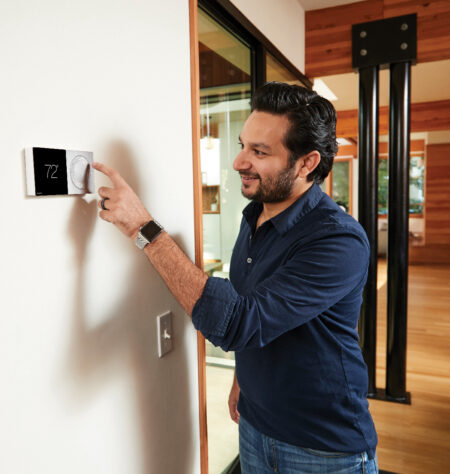
One of the best ways to curb the costs of heating and cooling your Wausau, WI home is by optimizing your thermostat settings. According to the U.S. Department of Energy (DOE), adjustments of 7 to 10 degrees when sleeping or leaving could result in energy savings as high as 10% annually. Smart and programmable thermostats make timed adjustments like these easy. Far superior to the simple, standard thermostats of yore, these devices all but eliminate human error. They also offer impressive levels of convenience.
Programmable Thermostats: How Do These Devices Work?
If you’re still using a standard thermostat, you must make every temperature adjustment manually. For busy professionals, this leads to both oversights and anxiety. If you dash out the door with your AC running, you’ll spend money to cool your empty home until you return, and you’ll likely worry about the effects on your monthly energy bill.
Programmable thermostats prevent oversights and other human errors by allowing homeowners to pre-set multiple temperature adjustments. For instance, you can program your thermostat to raise or lower your temperature whenever you’re away and to restore comfortable conditions just before you return home. You can also program your thermostat to slightly adjust your indoor temperature while you sleep and again before you wake up. Programmable thermostats offer an easy and reliable way to curb energy consumption without drastically altering residents’ comfort.
Programmable thermostats have various preset scheduling options, such as:
- Week-long schedules that repeat daily
- Seven one-day schedules with varied daily settings
- Separate schedules for weekdays and weekends
- Weekday schedules with different settings for each weekend day
The beauty of programmable thermostats is that they’re relatively low-cost, easy to install, and don’t require internet connections.
Who Can Save Money With a Programmable Thermostat?
Programmable thermostats are perfect for people with busy but relatively static schedules. If you want a thermostat that exceeds the limited capabilities of a standard thermostat but don’t want to spend a lot of money, a programmable thermostat offers an affordable introduction to innovative temperature regulation technologies.
How Smart Thermostats Differ From Programmable Thermostats
Just like programmable thermostats, smart thermostats allow users to pre-set multiple temperature adjustments. However, smart thermostats are Internet-connected, learning devices. Thus, they can optimize their temperature settings based on the comings and goings of building residents, changes in indoor and outdoor conditions, and many other factors. They’re among the top options in integrative smart home technologies, especially among eco-conscious consumers seeking to cut their carbon footprints.
As learning devices, smart thermostats constantly collect information. Via their web connections, they can draw local temperature and humidity data and adjust HVAC activities accordingly.
Most models have built-in motion detectors and sensors that monitor the movements of residents into, out of, and throughout homes. With motion detection, if you dash out the door unexpectedly, your air conditioner, heat pump, or heater will receive commands to maintain your preferred “away” conditions. With time, smart thermostats become increasingly adept at adjusting themselves for optimum HVAC efficiency and performance.
What a Smart Thermostat Can Do That a Programmable One Won’t
There are many things that a smart thermostat can do that a programmable thermostat cannot. This is especially true when it comes to saving homeowners money.
Are you wondering how to pick the best thermostat? Read here >>>
Remote Access
Smart thermostats come with branded mobile apps. You can download your smart thermostat’s mobile app to your laptop, tablet, mobile phone, or other Internet-connected device. Some smart thermostats are even compatible with smartwatch technologies.
Using your thermostat’s mobile app, you can access all the device’s real-time alerts, make temperature adjustments remotely, and alter pre-set temperature changes. Not only does this save homeowners money, but it also contributes to peace of mind. If you have family members who alter your thermostat’s settings whenever you’re away, you can establish user permissions or correct unwanted temperature adjustments as needed.
Detailed Energy Consumption Reports
Smart thermostats use the data they collect to create comprehensive energy consumption reports. If you have a smart thermostat, you can use its reports to track your energy use, identify changes in your HVAC system’s efficiency, and make changes to your settings to further reduce energy bills.
HVAC Performance Alerts
Smart thermostats send out regular and urgent performance alerts. If your air conditioner, heat pump, or furnace overheats, short cycles, or experiences any other adverse changes in performance, you’ll know right away. HVAC performance alerts make it easy to schedule timely repairs. They help homeowners identify and address developing problems before they spiral out of control.
Indoor Air Quality Alerts
Indoor air quality (IAQ) alerts from smart thermostats inform consumers of the need for HVAC maintenance, integrated IAQ accessories, or other interventions. Some devices inform homeowners of increases in airborne particulates, volatile organic compounds (VOCs), radon, and carbon monoxide (CO). With insightful info on your home’s humidity and air safety, you can avoid unpleasant IAQ-related symptoms and spend less at the pharmacy. You’ll also have the right information to optimize HVAC performance and improve your home’s safety.
Service Reminders
Stay up to date with professional HVAC maintenance and air filter replacements with a smart thermostat. Many smart thermostats send air filter and tune-up service reminders throughout the year. These alerts help homeowners maintain compliance with their HVAC manufacturers’ warranties.
Smart Thermostats With Geo-Fencing Capabilities
For homeowners with zoned HVAC systems, smart thermostats with geo-fencing capabilities are often the best choice. Zoning systems divide HVAC air distribution systems into several service areas with independently controlled thermostats. Geo-fencing establishes virtual boundaries around these zones. Thermostats then track users’ movements through, into, and out of these zones. Thus, if you leave your living room to relax in your bedroom, your smart thermostats will direct conditioned air away from your prior location and into your most current one. With geo-fencing thermostats, homeowners don’t have to waste money on heating or cooling unoccupied spaces.
Smart Thermostats and Integrative Smart Home Technologies
You can integrate your smart thermostat with your other smart home technologies, including your smart home hub. Integrated smart thermostats seamlessly coordinate with smart blinds and other smart window treatments, smart fans, integrated IAQ accessories, and more.
Comparing Costs
A high-end smart thermostat could cost you several hundred dollars more than a programmable thermostat. You’ll also need a dedicated Internet connection to support this device. However, from issuing early alerts of HVAC problems to allowing for remote settings corrections, a smart thermostat will save you money in more ways and generate more savings over time.
When Is a Smart Thermostat the Better Choice?
Programmable thermostats tend to work well for people who regularly leave and arrive home at the same time. You’ll get the best results from a programmable thermostat if you have a small, manageable household and if everyone in your home has fairly static schedules. However, smart thermostats will produce fantastic long-term savings for busy, bustling families and those with fluctuating, high-demand HVAC use.
Smart Thermostats: Savings and Convenience in Wisconsin Homes
The debate between smart and programmable thermostats often comes down to how much active management you want to do versus letting technology handle it. Both types can save money compared to an old manual thermostat – but smart thermostats are proving their worth in real-world savings and ease of use:
- Adaptive Schedules = Less Guesswork: A programmable thermostat follows the schedule you set, which works well if your routine is consistent. A smart thermostat, however, learns your patterns and adapts if you come home early or stay out late. This means less heating or cooling an empty home unexpectedly, translating to more dollars saved without you lifting a finger. Studies show smart thermostats can trim HVAC energy use by about 8%–15% on average, on top of what a properly used programmable unit might save.
- Energy Usage Reports: Most smart models provide monthly energy reports or insights via their apps. You can see how weather or setting changes impacted your furnace run time. This feedback helps you fine-tune settings further. Some utilities in Wisconsin even integrate with certain smart thermostats for demand response programs, giving small bill credits for allowing minor temperature adjustments during peak times (all automated and usually unobtrusive to comfort).
- Remote Access for Our Crazy Weather Swings: With a smart thermostat, if Madison gets an unexpected 60°F “heat wave” in February and you’re away for the weekend, you can remotely turn the heat down to avoid wasting energy. Likewise, if a cold snap hits early, you can kick on the heat so you return to a warm house. That kind of flexibility isn’t possible with standard programmable units, which assume everything goes according to schedule.
- Voice and Smart Home Integration: Another convenience (and potential minor energy saver): smart thermostats integrate with Alexa, Google Home, etc. A simple voice command can adjust temperatures if you’re feeling chilly, rather than just cranking the heat and potentially forgetting to adjust it back down. Small adjustments on the fly can prevent overshooting your comfort range.
In terms of pure savings, a well-managed programmable thermostat can come close to a smart thermostat. The smart thermostat’s true advantage is making those savings easier to achieve and adding comfort conveniences. For many busy families, that means energy efficiency actually happens instead of being forgotten. If you’re considering an upgrade to a smart thermostat, Southport can recommend models that integrate well with your HVAC system and even help you navigate available energy rebates.
We help homeowners in Wausau leverage the latest HVAC efficiency technologies. We offer a fantastic selection of smart and programmable thermostats along with expert installation, maintenance, and repair services. We’re also a top choice for advanced heating, air conditioning, and indoor air quality solutions. To experience the benefits of smart or programmable thermostats firsthand, call Southport Plumbing, Heating & Cooling today to schedule an appointment.