Your HVAC system’s ductwork and insulation both play a large role in how efficient it is. Certain materials offer better protection against heat loss and air leakage. However, many of them also come with their own set of drawbacks. Speaking with a professional is the best way to choose the right insulation and ductwork for your house.
Pros and Cons of Sheet Metal Ductwork
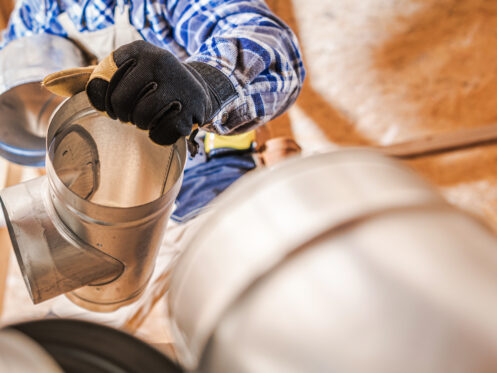
Ducts made of sheet metal are sturdy and durable. Their galvanized steel or aluminum construction gives them a reputation for a long lifespan. The smooth inside of these ducts facilitates improved airflow and makes them simple to clean. This is great news for the air quality inside your home. However, they are often more difficult to install and more costly than other kinds. These ducts may make a little racket when the air conditioner or heater turns on or off because the metal doesn’t absorb sound.
Pros and Cons of Flexible Ductwork
An inside coil of metal wire helps a flexible duct’s plastic tube maintain its form. They are straightforward to install and don’t take up much room, making them ideal for confined areas. Plus, they are less expensive than ducts made of metal. One drawback is that they lack toughness. They let air escape when they’re crushed or torn. And because the interior isn’t smooth like sheet metal, they collect a lot of dust. Failure to clean them regularly will lead to reduced air quality.
Pros and Cons of Fiberglass Ductwork
Fiberglass ducts are a type of metal duct that has either an outside or inside coating of fiberglass. Their enhanced insulation is their main advantage. They work wonderfully for reducing noise and preventing heat loss. On the other hand, the fiberglass can easily degrade over time and release microscopic particles into the air. These particles can irritate your lungs and skin. The fiberglass is also harder to clean. If you scrub too hard, it’s easy to damage the fiberglass.
Pros and Cons of Fabric Ductwork
Ducts constructed of fabric are common in commercial and institutional buildings, such as fitness centers and shopping malls, but they also find application in private residences. They are often less noisy than metal and disperse air more uniformly. However, fabric ducts usually can’t withstand the same level of wear and tear as their metal counterparts. Changing them out is probably in your best interest if they get soiled or ripped. Not all house styles work well with them, and they’re more costly.
Pros and Cons of Fiberboard Ductwork
Ducts composed of fiberboard consist of compressed fiberglass sheets backed with foil. In terms of air insulation, they are extremely effective. Their plush texture further reduces ambient noise. However, you should avoid using them in damp or rainy environments. Mold issues may arise when moisture becomes trapped. You should also know the duct’s rough inside might reduce airflow and attract additional dust. Scrubbing fiberboard can harm the material, so cleaning it is a real challenge. They do okay in dry settings but struggle in humid ones.
Pros and Cons of PVC Ductwork
The plastic material used to make PVC ducting has exceptional resistance to water. Basements and areas around pools are common locations to utilize it because of the potential for corrosion there. The inside of these ducts is smooth, allowing for simple cleaning and good airflow. Nonetheless, they cost more than standard metal or flexible ducts. They tend to struggle with high temperatures, which can be an issue for some HVAC systems.
Pros and Cons of Spiral Ductwork
Spiral ducts are similar to straight sheet metal ducts, except they have a twisted, spiral form. Because of this, they are sturdy and less likely to let air in. Their aesthetic appeal is high, particularly in contemporary or open-ceilinged houses. Spiral ducts keep noise to a minimum while efficiently circulating air, but they consume space. Additionally, they are more expensive to install than other choices.
Pros and Cons of Foil-Faced Insulation
Foil-faced insulation is quite popular. This type has a shiny foil layer that reflects heat. It’s great for keeping heat out in the summer and keeping warmth in during winter. It also acts as a moisture barrier. Some homeowners choose to install these ducts in places like attics or unfinished basements where temperature swings are normal. They are more expensive and trickier to install than other types, and they must have airtight sealing to perform correctly. Foil-faced insulation is not very thick, so it might not offer enough insulation on its own in colder areas.
Pros and Cons of Fiberglass Insulation
When it comes to residential insulation, fiberglass is among the most common choices. It’s available in a variety of forms, including rods, rolls or loose fill. It’s cheap and efficient at retaining heat. It’s also simple to install. However, fiberglass, particularly when disturbed, may irritate the skin and lungs. And since it soaks up water so easily, it can contribute to mold growth.
Pros and Cons of Spray Foam Insulation
When spray foam is sprayed over an area, the foam expands to fill any gaps. This feature makes it ideal for sealing air leaks and drafts. It gives ducts and walls more support as well. However, it requires a professional installer and is among the most costly solutions. The chemicals involved need cautious handling. Once installed, though, it requires little maintenance and lasts for a long time.
Pros and Cons of Reflective Insulation
Foam or bubble wrap is a common padding material for reflective insulation, which otherwise functions similarly to foil-faced insulation. It’s perfect for places where heat is a major problem. It will keep your home cooler by reflecting the sun’s rays and other radiant heat. Installation is a breeze, and it’s not heavy either. But, similar to foil-face, it isn’t as effective in cold climates without additional insulation.
How to Choose the Right Ductwork and Insulation for Your Home
Before you choose the ideal insulation and ductwork for your property, determine its exact requirements. Size, style, location and construction method all contribute to the uniqueness of each house. Insulation that is both water-resistant and heat-resistant is essential if you reside in a hot and humid climate. Houses situated in colder climates like Madison, WI, may require materials that effectively retain warmth.
How much room you have for ductwork is another factor. In confined spaces, flexible ducts may be more practical. In wider, more open regions, metal or spiral ducts might be more appropriate. If you value a peaceful working environment, make sure to choose materials that help reduce noise pollution.
The most prudent course of action is to consult experts. They can assess your current HVAC setup and provide a tailor-made configuration for your home.
Southport Home Services is here to answer any questions you have about ductwork and insulation materials. We help homeowners create heating and cooling setups that deliver optimal comfort year-round. Our HVAC repairs, tune-ups and installations improve comfort throughout the house as well as indoor air quality through duct cleaning. Call Southport Home Services today to speak with a professional HVAC expert in Madison.